English
 简体中文
简体中文
 Русский
 Español
 Árabe
Árabe
 日本語
日本語
 한국어
한국어

How to Choose the Right Pet Products for Your Target Market
Meta Title
How to Choose the Right Pet Products for Your Target Market
Meta Description
Learn how to select pet training pads, dog diapers, cat litter, and cat scratchers based on your target customers, sales channels, pricing, and market positioning.
After understanding the opportunities in the pet care market, the next step is deciding which products are suitable for your business.
A product that performs well in one market may not be suitable for another. Customer habits, pet ownership patterns, retail channels, price expectations, packaging preferences, and local competition can all influence product selection.
For brands, importers, and distributors, the goal is not to choose the largest possible product range. The goal is to build a range that is easy to position, sell, supply, and expand.
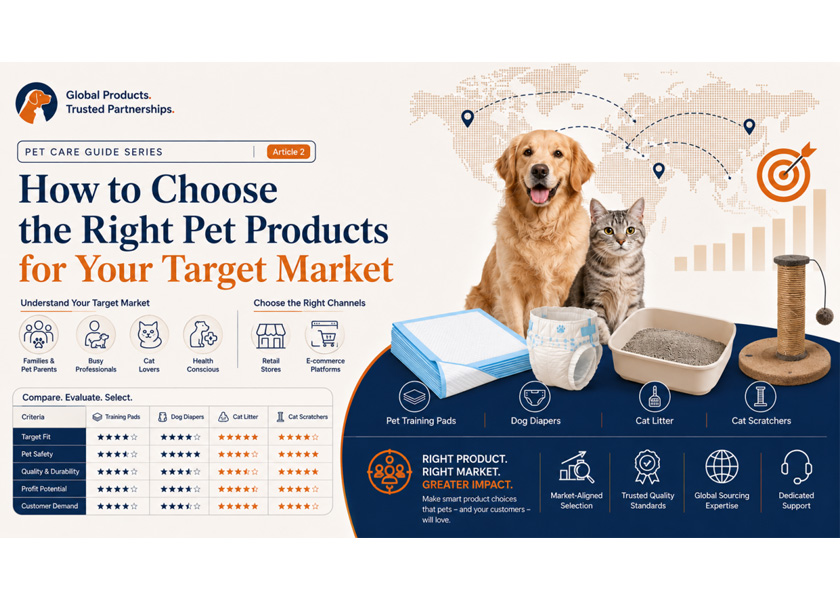
This article explains how to evaluate pet products based on target market requirements.
Start with Your Target Customer
The first question is not “Which pet product is popular?” It is:
Who will buy this product, and why?
Different customer groups may value different product features.
Price-Sensitive Customers
Price-sensitive consumers usually focus on practical performance and affordability.
Products for this group may require:
· Simple packaging
· Standard specifications
· Competitive pack quantities
· Basic but reliable performance
· Clear value communication
For example, an economy training pad should still provide reasonable absorption and leak protection, even if the packaging and material structure are simplified.
Mainstream Retail Customers
Mainstream consumers generally expect a balance between quality, price, appearance, and convenience.
Products may need:
· Attractive retail packaging
· Clear product benefits
· Reliable sizing or specifications
· Consistent performance
· Several options within the same category
This segment often suits brands that want broad retail coverage.
Premium Customers
Premium buyers may pay more for improved comfort, stronger performance, refined materials, natural positioning, or better packaging.
Possible premium features include:
· Higher absorbency
· Softer surface materials
· Odor-control functions
· Low-dust cat litter
· More durable scratchers
· Sophisticated packaging
· Specialized product claims supported by testing
Premium positioning must be supported by visible and practical product differences.
Match the Product to the Sales Channel
Product selection should also reflect where the item will be sold.
For Supermarkets
Supermarket products need clear shelf communication.
Suitable products usually have:
· Familiar formats
· Easy-to-understand functions
· Stable packaging sizes
· Competitive retail prices
· Strong visual recognition
Training pads, cat litter, and standard dog diapers may be suitable for this channel because consumers can understand their purpose quickly.
For Pet Specialty Stores
Pet stores can support more specific products, including:
· Multiple dog diaper sizes
· Specialized absorbency levels
· Premium cat litter
· Creative cat scratchers
· Products for older or recovering pets
Detailed product knowledge and staff recommendations can help these items sell.
For E-Commerce
Online products require strong visual presentation and clear descriptions.
Buyers should consider:
· Shipping weight
· Carton strength
· Packaging damage risk
· Product dimensions
· Consumer reviews
· Repeat-purchase potential
· Ease of comparison
Lightweight or compressed packaging may provide logistical advantages, but the product must still remain protected during transportation.
For Wholesale Distribution
Distributors often need products that can serve several retail customers.
They may prefer:
· Standardized specifications
· Flexible packaging options
· Multiple price levels
· Stable supply
· Mixed product portfolios
· Private label support
A supplier capable of coordinating several related categories may help simplify procurement.
Evaluate Each Product Category
Once the target customer and channel are clear, buyers can evaluate individual categories.
Pet Training Pads
Training pads are often a practical starting point because they serve several usage scenarios.
They can be used for:
· Puppy training
· Indoor toileting
· Older dogs
· Travel
· Pet carriers
· Post-surgery recovery
· Temporary floor protection
When choosing a training pad, consider:
· Pad size
· Total weight
· Absorbent core structure
· SAP and fluff pulp content
· Surface softness
· Leak-proof back sheet
· Edge sealing
· Absorption speed
· Rewet performance
· Adhesive strips
· Color and printing
· Pack quantity
For entry-level products, standard sizes and simple packaging may be sufficient. For premium or specialized markets, buyers may consider higher absorbency, attractants, odor-control materials, or distinctive printed designs.
Dog Diapers
Dog diapers require greater attention to size and fit.
Important factors include:
· Waist range
· Product length
· Tail-hole design
· Elasticity
· Fastening system
· Leak guards
· Absorbency
· Surface comfort
· Gender-specific use
A product may perform well in terms of absorption but still receive poor customer feedback if the sizing is unclear.
Brands should provide easy-to-understand size charts and consider whether they need products for female dogs, male dogs, or both.
Cat Litter
Cat litter selection depends heavily on consumer habits and regional preferences.
Buyers should evaluate:
· Material type
· Clumping speed
· Clump strength
· Odor control
· Dust level
· Absorption
· Tracking
· Fragrance
· Color
· Disposal method
· Packaging weight
Heavy products may create higher transportation costs, while lightweight materials may require additional consumer education.
It is also important to determine whether the market prefers scented, unscented, natural, or traditional litter.
Cat Scratchers
Cat scratchers are more design-oriented than hygiene products.
Key considerations include:
· Shape
· Size
· Cardboard quality
· Density
· Durability
· Stability
· Printing
· Retail packaging
· Storage efficiency
· Assembly requirements
Creative shapes can attract consumers, but complex designs may increase packaging size and shipping costs.
A good product should balance appearance, pet usability, production efficiency, and transportation.
Consider Product Combination Opportunities
Related pet products can support cross-selling.
For example:
· Training pads and dog diapers can serve puppy, senior pet, and indoor hygiene needs.
· Cat litter and cat scratchers can form a basic cat care range.
· Hygiene products can be offered in economy and premium versions.
· Different products can share a consistent private label packaging system.
A coordinated product portfolio may help a brand appear more established and make it easier for distributors to present a complete range to retailers.
However, the products should still share a clear customer group or brand positioning.
Define Customization Requirements Early
Before requesting samples or quotations, buyers should clarify which aspects must be customized.
Common customization options include:
· Product size
· Weight
· Absorbency
· Material
· Color
· Fragrance
· Printing
· Adhesive design
· Pack quantity
· Bag design
· Carton design
· Brand label
· Product instructions
Not every feature needs to be customized.
Using standard specifications with custom packaging may be suitable for a new brand testing the market. More complex product customization may be appropriate after demand is confirmed.
Balance Differentiation and Cost
Many buyers want a product that is clearly different from competitors, but every added feature may affect cost, minimum order quantity, production complexity, or delivery time.
The most effective differentiation is not always the most complicated.
Examples of practical differentiation include:
· A better size combination
· Clearer packaging
· Improved absorbency
· More convenient pack quantity
· Stronger odor control
· Better sizing information
· A more suitable product bundle
The product should solve a real customer problem rather than simply include more features.
Test Before Expanding
Sampling is an important part of product selection.
Buyers should evaluate:
· Appearance
· Dimensions
· Weight
· Absorption
· Leakage
· Fit
· Packaging
· Product odor
· Durability
· Ease of use
Feedback from retail partners or a small test group may also help identify problems before large-scale ordering.
For a new market, it is often safer to begin with a focused product range and expand after receiving sales data and customer feedback.
Work with a Supplier That Understands Your Market
A suitable supplier should do more than provide a price.
The supplier should be able to discuss:
· Product positioning
· Specification options
· Packaging requirements
· Quality standards
· Production feasibility
· Order quantities
· Export arrangements
· Potential risks
At Kilo-Promise, our team supports customers in developing pet training pads, dog diapers, cat litter, and cat scratchers for different markets and channels. We help buyers compare specifications, prepare private label packaging, coordinate production, and manage export requirements.
Conclusion
Choosing the right pet products requires a clear understanding of the target customer, sales channel, price level, product function, and supply capability.
Pet training pads may suit businesses seeking repeat-purchase hygiene products. Dog diapers can serve more specialized care needs. Cat litter provides strong ongoing demand, while cat scratchers offer opportunities for visual and design differentiation.
The best product range is not necessarily the largest. It is the one that matches the market and can be supplied consistently.
Among these categories, pet training pads are often one of the most practical products for brands and distributors to develop first.
In the next article, we will examine the materials, structures, functions, and positioning options that buyers should understand when developing pet training pads.