English
 简体中文
简体中文
 Русский
 Español
 Árabe
Árabe
 日本語
日本語
 한국어
한국어

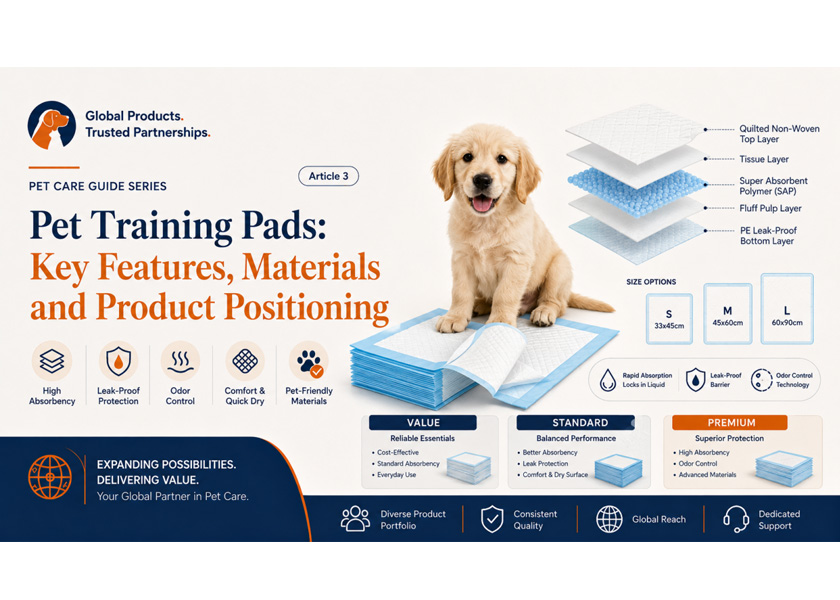
Pet Training Pads: Key Features, Materials and Product Positioning
Meta Title
Pet Training Pads: Features, Materials and Product Positioning
Meta Description
Learn how to evaluate pet training pad materials, absorbency, sizes, functions, packaging, and market positioning for OEM and private label development.
After identifying suitable pet product categories for a target market, many brands and distributors choose pet training pads as one of their first products to develop.
Training pads are widely used for puppy training, indoor toileting, senior pet care, travel, post-surgery recovery, and temporary floor protection. They are practical, easy for consumers to understand, and suitable for repeat purchasing.
However, training pads that appear similar from the outside may perform very differently. Product weight, absorbent materials, surface design, sealing quality, back-sheet strength, and packaging can all influence the final user experience.
For buyers developing an OEM or private label product, understanding these details is essential.
Understanding the Basic Structure of a Pet Training Pad
A typical pet training pad contains several functional layers.
Nonwoven Top Sheet
The top sheet is the layer that comes into contact with the pet.
It should allow liquid to pass into the absorbent core while helping the surface remain relatively dry. The softness, strength, and liquid penetration speed of the nonwoven material can affect both comfort and performance.
A surface that is too weak may tear or deform during use, while a surface that transfers liquid too slowly may leave more moisture on top.
Tissue Layers
Tissue paper may be used above or below the absorbent core to help distribute liquid and improve structural stability.
The number and quality of tissue layers can influence how evenly liquid spreads across the pad.
Fluff Pulp and SAP Absorbent Core
The absorbent core usually combines fluff pulp with superabsorbent polymer, commonly known as SAP.
Fluff pulp helps distribute and temporarily hold liquid, while SAP absorbs liquid and turns it into gel.
A higher SAP content does not automatically guarantee a better product. The balance between SAP, fluff pulp, core weight, distribution, and pad size also matters.
If too much SAP is concentrated in a small area, the product may swell unevenly. If there is insufficient fluff pulp, liquid may not spread efficiently through the core.
Tissue or Core-Wrapping Layer
Some pads use an additional wrapping layer around the absorbent materials.
This can help reduce movement of the core and improve product stability during production, transportation, and use.
PE Back Sheet
The polyethylene back sheet provides leak protection.
It should be strong enough to resist tearing and prevent liquid from reaching the floor. Buyers may choose different colors, printing designs, thicknesses, and surface textures.
The back sheet can also include adhesive strips to help keep the pad in place.
Key Performance Factors Buyers Should Evaluate
Training pad performance should not be evaluated using only one number.
Several factors work together.
Absorption Capacity
Absorption capacity refers to the amount of liquid the pad can hold under test conditions.
Buyers should confirm how the supplier measures this value because different testing methods may produce different results.
A very high laboratory absorption value does not necessarily mean the pad will perform well in real use. Absorption speed, distribution, and rewet performance are also important.
Absorption Speed
Absorption speed affects how quickly liquid enters the core.
Faster absorption can reduce surface pooling and lower the risk of liquid spreading toward the edges.
This is especially important for active pets or products designed for repeated use over several hours.
Liquid Distribution
Good liquid distribution allows more of the absorbent core to be used.
If liquid remains concentrated in one area, the pad may leak even when other parts of the core are still dry.
The combination of top-sheet penetration, tissue layers, fluff pulp, embossing, and core structure can influence distribution.
Rewet Performance
Rewet refers to the amount of moisture that returns to the surface after pressure is applied.
Lower rewet can help keep paws drier and improve the user experience.
For premium products, buyers may place greater emphasis on surface dryness and odor control.
Leak Protection
Leak protection depends on the back sheet, edge sealing, core placement, and total absorbency.
Weak sealing or an undersized core may cause leakage even when the materials themselves are acceptable.
Buyers should inspect the four edges and corners carefully during sample evaluation.
Product Strength
The pad should remain intact when unfolded, moved, or stepped on by a pet.
The top sheet, back sheet, embossing, and edge sealing all contribute to overall strength.
Common Pet Training Pad Sizes
Training pads are available in many dimensions.
Common sizes include:
45 × 60 cm
60 × 60 cm
60 × 90 cm
76 × 90 cm
Custom dimensions
Smaller pads may suit puppies, small dogs, carriers, or compact indoor spaces.
Larger pads may be used for bigger dogs, senior pets, whelping areas, cages, or broader floor protection.
Size selection should reflect pet size, usage frequency, retail price, packaging quantity, and local consumer habits.
A larger pad does not always require the highest absorbency. The correct specification depends on how the product will be used and positioned.
Product Weight and Core Specification
Buyers often compare training pads by total product weight, fluff pulp content, and SAP content.
These figures are useful, but they should be considered together.
Two pads with the same total weight may still differ because one may use:
A heavier back sheet
A thicker top sheet
More tissue
More fluff pulp
More SAP
A larger absorbent core area
For this reason, a complete specification sheet is more useful than a single weight figure.
During product development, buyers should confirm:
Total pad weight
SAP content
Fluff pulp content
Core dimensions
Top-sheet specification
Back-sheet specification
Tissue structure
Adhesive design
Packaging quantity
Functional Options for Different Markets
Training pads can be customized with additional features.
Attractant
An attractant may be added to support puppy training.
However, attractant type and effectiveness can vary. Buyers should confirm the material, application method, and target market requirements before making product claims.
Odor-Control Materials
Odor-control functions may be added through fragrance, activated carbon, or other materials.
These features may suit indoor-use or premium products, but consumer preferences differ. Some buyers prefer unscented products, while others value fragrance or odor reduction.
Adhesive Strips
Adhesive strips help reduce pad movement on smooth floors.
The number, position, and adhesive strength should be tested. Adhesive that is too weak may be ineffective, while overly strong adhesive may leave residue.
Printed Back Sheet
Printed designs can improve product recognition and private label differentiation.
Patterns may also help consumers identify the correct side of the pad.
Color Options
Blue, green, pink, white, or customized colors may be selected according to brand identity and market preferences.
Color should remain consistent between batches.
Embossing Patterns
Embossing can support liquid distribution and improve the appearance of the product.
Different patterns may create different visual and functional effects, but embossing alone should not be presented as proof of better absorbency.
Economy, Mainstream and Premium Positioning
Product positioning should guide the specification.
Economy Training Pads
Economy products generally focus on essential performance and cost control.
They may use:
Standard materials
Lower total weight
Simple packaging
Common dimensions
Basic absorbency
Fewer additional functions
The product must still provide acceptable leak protection and consistent quality.
Mainstream Retail Training Pads
Mainstream products usually balance price, appearance, absorbency, and packaging.
They may include:
Better liquid distribution
Improved surface quality
Printed or colored back sheets
Retail-ready packaging
Several sizes or pack quantities
Clear usage instructions
This level suits many supermarkets, pet stores, distributors, and online sellers.
Premium Training Pads
Premium products need visible and meaningful differences.
Possible features include:
Higher absorbency
Faster liquid penetration
Lower rewet
Softer top sheets
Odor-control materials
Activated carbon
Stronger adhesive strips
Premium printing
More refined packaging
Premium positioning should be supported by testing and clear product communication.
Packaging Considerations
Packaging affects product cost, shelf presentation, transportation, and consumer convenience.
Buyers should consider:
Number of pads per pack
Folding method
Compression level
Bag material
Handle design
Printing colors
Outer carton size
Carton strength
Barcode and label requirements
Instructions and warnings
For e-commerce, packaging should withstand transportation and avoid unnecessary volume.
For retail stores, front-panel communication and pack appearance may be more important.
Private label packaging should clearly show:
Pad size
Quantity
Main functions
Recommended use
Product structure or features
Storage instructions
Brand information
Testing Samples Before Ordering
Before confirming a bulk order, buyers should evaluate several samples rather than relying only on photos or specification tables.
Sample testing may include:
Product dimensions
Individual weight
Core placement
Absorption speed
Total absorption
Rewet
Leakage
Edge sealing
Back-sheet strength
Adhesive performance
Packaging quality
Product odor
Samples should also be compared with competing products from the target market.
This helps buyers understand whether the specification matches local price and performance expectations.
Working with an OEM Supplier
A suitable OEM supplier should be able to explain how changes in materials, weight, SAP, size, packaging, and additional functions affect product performance and cost.
At Kilo-Promise, we support the development of pet training pads in different sizes, absorbency levels, colors, printing designs, packaging formats, and functional configurations.
Our team works with customers to confirm product specifications, prepare samples, coordinate private label packaging, and follow production requirements.
Conclusion
Pet training pads may appear simple, but successful product development requires careful decisions about materials, absorbency, size, function, packaging, and positioning.
Economy, mainstream, and premium products should not use the same specification strategy. Each product should be developed around a clear target customer, sales channel, and retail price.
For many brands and distributors, training pads provide a practical entry point into the pet hygiene market because they support repeat purchasing and flexible OEM development.
Once a pet hygiene range begins to expand, dog diapers are often the next category to consider. Unlike training pads, however, dog diapers require greater attention to fit, sizing, comfort, and body shape.
In the next article, we will explain how to develop dog diapers for different breeds, sizes, and usage needs.